
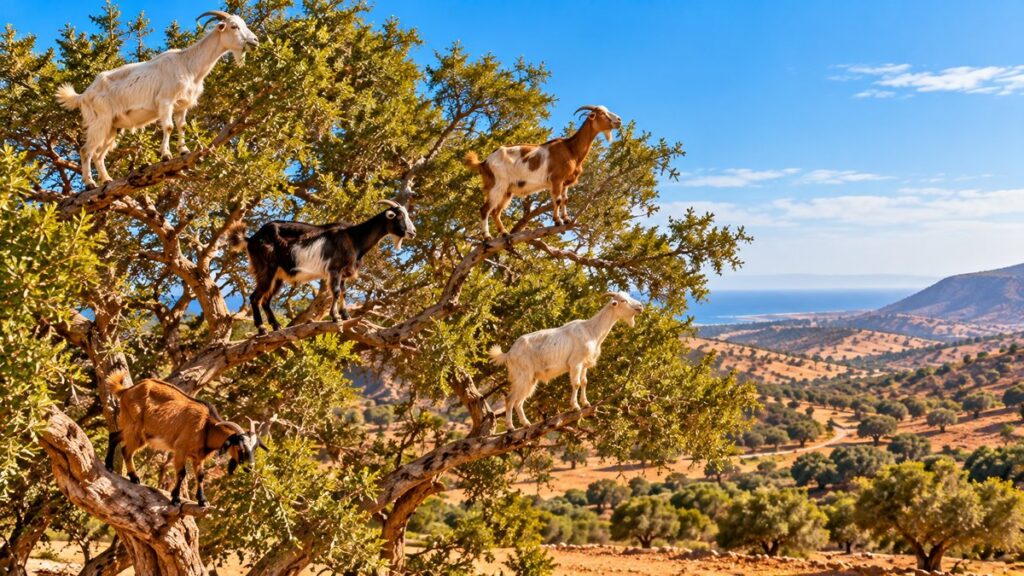
The famous tree-climbing goats of Morocco live in the argan forest around Agadir and Essaouira. Goats climb argan trees to eat the leaves and fruit, mostly in late spring and summer when the fruit is ripe. The easiest way to see them is on the road between Agadir and Essaouira or on a half-day tour from Agadir that also visits an argan oil cooperative. In this guide our local team explains where to go, what is natural, what is staged, and how to visit responsibly.
Tree-climbing goats at a glance
- Where: the argan forest of south-west Morocco, mainly between Agadir, Essaouira and Taroudant
- Best season: May to August, when argan fruit is on the trees; you can see them all year at some stops
- Best time of day: morning
- From Agadir: 30 to 90 minutes by road depending on the spot
- Tours: goats and Crocoparc from €45, cable car, Crocoparc and goats from €65, or the Essaouira day trip from €40
Why do goats climb trees in Morocco?
The argan tree (Argania spinosa) grows only in south-west Morocco. Its branches are low, twisted and strong, and its leaves and olive-like fruit are tasty for goats. In this dry region, grass is rare in summer, so goats learned to climb into the trees to find food. Young goats are especially agile and can stand on surprisingly thin branches.
The argan forest is so important that UNESCO declared the region a biosphere reserve in 1998. The trees protect the soil against the desert, give shade and provide income to thousands of families.
Natural goats or a show for tourists?
Here is the honest truth. Goats really do climb argan trees on their own, especially when the fruit is ripe. But at some roadside stops, especially on the Agadir to Essaouira road, herders place goats in trees all day so tourists can take photos for a tip. Some animals stay in the sun for hours on platforms, which is not good for them.
How to tell the difference:
- Natural: goats move freely, climb up and down, eat, and the herd moves on.
- Staged: the same goats stand still on wooden platforms all day, often next to a car park, and someone asks for money for photos.
We prefer stops where the herd moves freely, and we limit the time spent at staged spots. If you see animals without shade or water, it is better not to pay for photos.
Where to see tree-climbing goats from Agadir
On the road to Essaouira
The N1 coast road north of Agadir crosses large areas of argan forest. This is where most visitors see goats in trees, as a stop on the Essaouira day trip. Read our full Essaouira day trip guide.
Near Agadir on a half-day tour
If you do not want a full day in the car, the tree-climbing goats and Crocoparc tour combines the goats, an argan cooperative and the crocodile park in about 5 to 6 hours. Families also like the cable car, Crocoparc and goats tour.
Towards Taroudant and the Souss valley
The road inland to Taroudant passes argan trees and quiet villages where herders graze their goats. You may see them on the Taroudant and Tiout oasis day trip.
How argan oil is made
Most tours include a visit to a women’s argan oil cooperative. Here is what you will see:
- Collecting: the fruit is collected from the ground when it falls, then dried in the sun.
- Peeling: the dry pulp is removed to reveal a very hard nut.
- Cracking: women crack the nuts between two stones by hand to take out the kernels. It is slow and skilled work.
- Roasting (for culinary oil): kernels are lightly roasted for a nutty taste. Cosmetic oil uses raw kernels.
- Grinding and pressing: the kernels are ground into a paste and pressed to extract the oil.
It takes a lot of fruit and many hours of work to make one litre of argan oil, which is why real argan oil is not cheap. Cooperatives give women a fair income and independence.
Argan oil: culinary or cosmetic?
| Culinary argan oil | Cosmetic argan oil | |
|---|---|---|
| Kernels | Roasted | Raw |
| Colour and smell | Darker, nutty, toasted | Light gold, almost no smell |
| Use | Bread dipping, salads, couscous, amlou spread | Skin, hair, nails, massage |
| Tip | Taste amlou (argan, almonds and honey) | Check it is 100% argan with no added oils |
Want to feel argan oil on your skin? Try a hammam with argan oil massage; see our hammam guide. For shopping, read our Souk El Had guide.
Tips for a responsible visit
- Ask your guide to stop where goats move freely rather than at fixed photo platforms.
- Keep a distance and do not touch or feed the goats.
- If you take photos of a herder’s goats, a small tip is normal; agree before.
- Buy argan oil from a cooperative, not from roadside sellers with unlabeled bottles.
- Do not climb on or damage the argan trees.
Other animals and sights in the argan forest
The argan forest is not only about goats. You may see shepherds with their flocks, donkeys carrying loads, storks nesting on old buildings and small Berber villages with stone houses. In spring, the hills are green and covered with flowers. Some tours also stop at a viewpoint over the Atlantic, where the argan trees grow almost down to the ocean.
Best photos of the goats
- Use a medium zoom: you can stay at a respectful distance and still fill the frame.
- Morning light is softer and the goats are more active.
- Shoot from slightly below to show the goats against the sky and the tree.
- Be patient: the best photos come when the goats move naturally, not when they are posed.
Combine the goats with other activities
The goats are a perfect stop for families; see our guide to Agadir with kids. You can also add a camel ride or a Paradise Valley trip on another day. For more ideas, browse the 25 best things to do in Agadir and all activities in Agadir.
More travel guides
- Essaouira Day Trip from Agadir: Itinerary, Prices and Tips
- Souk El Had Agadir: Opening Hours, What to Buy and Tips
- Hammam in Agadir: What to Expect, Prices and Etiquette
- Agadir with Kids: 15 Family Activities Children Love
- 25 Best Things to Do in Agadir (2026 Local Guide)
Frequently asked questions
Where can I see tree-climbing goats in Morocco?
In the argan forest of south-west Morocco, mainly on the road between Agadir and Essaouira, around Agadir and towards Taroudant.
Why do goats climb trees in Morocco?
Goats climb argan trees to eat the leaves and fruit, especially in the dry season when there is little grass on the ground.
When is the best time to see the goats in the trees?
From May to August, when argan fruit is ripe, and in the morning. You can see goats in trees at some stops all year.
Are the tree-climbing goats real or staged?
Both. Goats really climb argan trees naturally, but some roadside stops place goats on platforms for tourist photos. Choose stops where herds move freely.
Is there a tour to see the goats from Agadir?
Yes. Half-day tours from Agadir combine the goats, an argan oil cooperative and Crocoparc, and the Essaouira day trip also stops to see them.
Written by the YouTours team in Agadir. Last updated: October 2026.