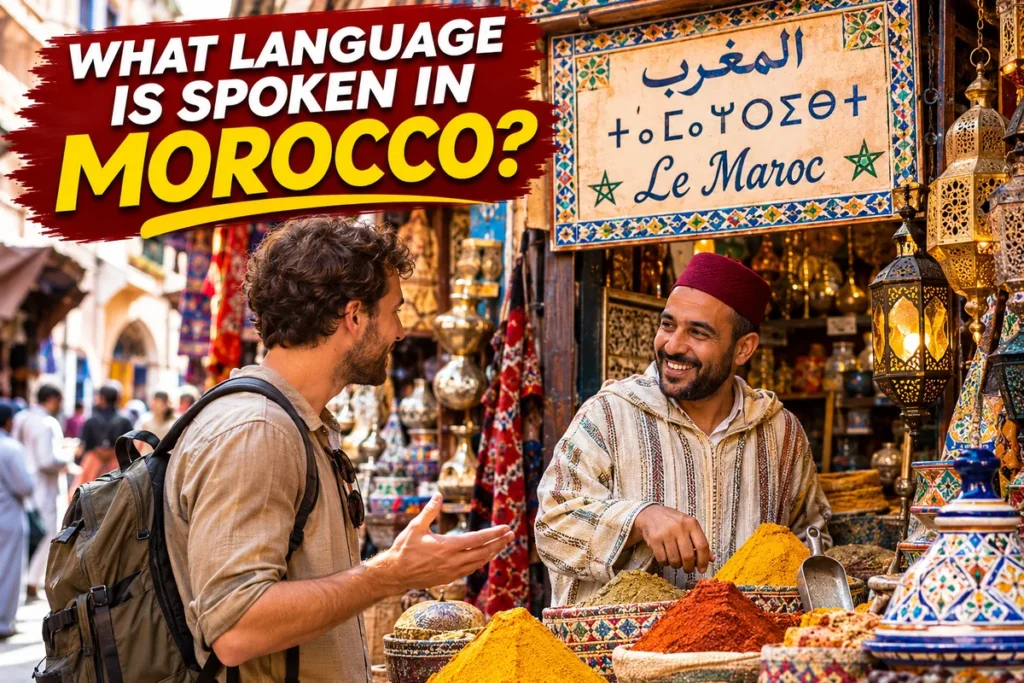
What language is spoken in Morocco? It is one of the first questions travellers ask, and the answer is more interesting than most people expect. Morocco has two official languages, Arabic and Amazigh (Berber), but the language you will hear most in the street is Darija, Moroccan Arabic. French is everywhere in business, menus and road signs, Spanish is common in the north, and English is growing fast, especially among young people and in tourist areas. We live in Agadir and work with travellers from all over the world every day, so this guide explains, simply and honestly, which language is spoken in Morocco, where, by whom, and what it means for your trip.
What language is spoken in Morocco? The short answer
- Official languages: Standard Arabic and Amazigh (Tamazight), both recognised in the 2011 Constitution.
- Most spoken language: Darija (Moroccan Arabic). According to the 2024 national census, about 92% of the population speaks it.
- Amazigh (Berber) languages: spoken by about a quarter of the population according to the same census, a figure that some Amazigh associations consider too low.
- French: not official, but widely used in business, administration, higher education, media and tourism.
- Spanish: common in the north (Tangier, Tetouan) and in parts of the far south.
- English: growing quickly, especially among young Moroccans and in hotels, restaurants and tour companies.
- Hassaniya: an Arabic variety spoken in the Saharan provinces of the south.
So if you are asking “what is the main language in Morocco?”, the honest answer is Darija for everyday life, Arabic and Amazigh officially, and French as the main foreign language.
The official languages of Morocco
Standard Arabic
Modern Standard Arabic is the language of the state, official documents, schools, news bulletins, religious life and most formal writing. It is the same written Arabic used across the Arab world. However, almost nobody speaks Standard Arabic in daily conversation. Moroccans learn it at school and use it to read and write, but at home, in the market or in a taxi, they speak Darija.
Amazigh (Berber)
Amazigh, also called Berber or Tamazight, is the language of the indigenous people of North Africa, spoken in Morocco long before Arabic arrived. Since the 2011 Constitution, Amazigh has been an official language alongside Arabic. You will notice its own alphabet, Tifinagh, on public buildings, road signs and banknotes. The characters look geometric, with circles, lines and crosses, and many travellers mistake them for decoration.
Amazigh is not a single uniform language. In Morocco, there are three main varieties:
- Tachelhit (Tashelhit): spoken in the Souss region, the Anti-Atlas and parts of the High Atlas, including the area around Agadir, Taroudant and Tafraoute.
- Tamazight (Central Atlas Tamazight): spoken in the Middle Atlas and parts of the High Atlas.
- Tarifit (Riffian): spoken in the Rif mountains in the north, around Al Hoceima and Nador.
Many Amazigh speakers are bilingual and also speak Darija, often French too.
Darija: the real everyday language of Morocco
Darija is Moroccan Arabic. It is what you will hear in the souks, cafés, buses and homes. It comes from Arabic, but it has absorbed many words from Amazigh, French and Spanish over the centuries, and its pronunciation and grammar are quite different from Standard Arabic. An Arabic speaker from the Middle East may struggle to understand fast Darija at first, while Moroccans usually understand Middle Eastern Arabic easily thanks to television and music.
Darija is mostly a spoken language. It is written informally on social media and in messages, sometimes in Arabic script and sometimes in Latin letters with numbers for certain sounds (for example “3” for the Arabic letter ain, or “7” for a strong h). You will see this on shop signs, adverts and WhatsApp messages.
Some examples of Darija mixing languages:
- “Tomobil” for car, from the French “automobile”.
- “Simana” for week, from the French “semaine”.
- “Cuzina” for kitchen, from the Spanish “cocina”.
- “Wakha” for OK, a word you will hear a hundred times a day.
Do they speak French in Morocco?
Yes, very widely. French is not an official language, but it is a legacy of the French protectorate (1912–1956) and remains the main language of business, banking, higher education, science and much of the administration. Menus, price lists, road signs and official websites are often in Arabic and French. According to the 2024 census, more than half of literate Moroccans aged 10 and over can read and write French.
For French-speaking travellers, Morocco is very easy: in cities and tourist areas, almost everyone you deal with can speak French, from taxi drivers to hotel staff. In remote villages, it is less common, especially among older people.
Do they speak English in Morocco?
More and more. English has grown fast in the last decade, driven by young people, the internet, tourism and the education system, which is giving English a bigger place in schools. The 2024 census found that around one in five literate Moroccans aged 10 and over can read and write English, with higher figures in cities.
In practice, for an English-speaking traveller:
- Hotels, riads and tour companies: English is usually spoken well.
- Restaurants and shops in tourist areas: basic English is common, and sellers in the souks often speak several languages.
- Taxis and small local shops: English can be limited; a few words of French or Darija help a lot.
- Young people: many speak good English and are happy to practise it.
Agadir, Marrakech and Essaouira are particularly easy for English speakers because of the number of international visitors. If you book a guided activity, like our Agadir city tour (from €15), you can ask us in advance which languages your guide speaks.
Is Spanish spoken in Morocco?
Spanish is common in the north of Morocco, which was under Spanish protectorate until 1956, and in towns like Tetouan, Tangier, Larache and Al Hoceima. It is also understood in parts of the far south. Spanish television is widely watched in the north. Outside these regions, Spanish is less common than French, although many people working in tourism speak at least a little.
Hassaniya in the south
Hassaniya is an Arabic variety spoken in the Saharan provinces of southern Morocco, around Laayoune and Dakhla, and also in Mauritania. The 2024 census counted it as a small share of speakers nationally, but it is the main local language in parts of the far south.
Which language is spoken where? A regional overview
- Casablanca, Rabat, Fes, Meknes: Darija and French dominate.
- Marrakech: Darija, with Amazigh widely spoken in the surrounding Atlas villages, and French and English very common in tourism. See our guide to things to do in Marrakech.
- Agadir and the Souss region: Darija and Tachelhit, the local Amazigh language, with French and English widely spoken in hotels and tourism.
- The Atlas mountains: Amazigh is often the first language in villages, with Darija as a second language.
- The north (Tangier, Tetouan, Chefchaouen): Darija, Spanish, and Tarifit in the Rif.
- The Sahara and the south: Darija, Amazigh in the oases and valleys, and Hassaniya in the Saharan provinces.
Finding our local guides useful? Add YouTours as a preferred source on Google.
Languages in Agadir
Agadir is a good example of Morocco’s multilingualism. Many families in the region speak Tachelhit at home, Darija in the street and at work, French in business, and English with visitors. The city’s tourism industry means that hotel staff, guides, drivers and restaurant teams are used to switching languages several times a day. If you visit the Souk El Had of Agadir, you will hear Tachelhit, Darija and French in the same alley, and many sellers speak some English, Spanish or German too.
Taking a trip inland, for example to Paradise Valley (from €19) or the Anti-Atlas around Tafraoute (from €86), is a nice way to hear Tachelhit spoken in the villages, and you can ask your guide to teach you a few words.
Useful Darija phrases for travellers
Moroccans always appreciate it when visitors try a few words of Darija. Here are the most useful ones:
- Salam alaykoum: hello (the answer is “wa alaykoum salam”)
- Labas? how are you? / everything fine?
- Labas, hamdoullah: fine, thank God
- Choukran: thank you
- La, choukran: no, thank you (very useful in the souks)
- Afak: please
- Wakha: OK
- Bshhal? how much?
- Ghali bezzaf: too expensive
- Fin kayn…? where is…?
- Bslama: goodbye
- Inshallah: God willing (you will hear it constantly, for anything that will happen in the future)
A few Tachelhit (Amazigh) words
If you travel in the Souss region or the Atlas, these Tachelhit words will bring big smiles:
- Azul: hello
- Tanmirt: thank you
- Mamk tgit? how are you? (to a man)
- Ar tufat: see you later
Pronunciation varies from one region to another, so do not worry about being perfect: the effort is what counts.
Can you travel in Morocco without speaking Arabic or French?
Yes. Millions of tourists visit Morocco every year speaking only English, German, Italian or another language. In cities and tourist areas you will always find someone who speaks English, and translation apps fill the gaps. Some tips:
- Download an offline translation app with Arabic and French.
- Keep your hotel’s address written in Arabic and French for taxi drivers.
- Learn a few Darija words: they open doors and often lead to better prices in the souks.
- Use WhatsApp: hotels, riads, drivers and tour companies in Morocco use it constantly, and written messages are easier than phone calls.
- Book guided activities if you want explanations in your language.
More practical advice in our Morocco travel tips for first-timers.
A short history of languages in Morocco
Morocco’s linguistic map reflects its history. Amazigh languages are the oldest, spoken in North Africa for thousands of years. Arabic arrived with the Arab conquests from the 7th century and became the language of religion, learning and the state. Andalusian refugees brought their influence after the fall of Muslim Spain. In the 20th century, the French and Spanish protectorates left French and Spanish deeply rooted in administration, education and daily vocabulary. Since independence in 1956, Arabic has been the main official language, and in 2011 Amazigh was recognised as an official language too. Today, English is the newest arrival, carried by globalisation and young Moroccans.
Language and culture: a few things to know
- Code-switching is normal: Moroccans often mix Darija, French and sometimes English in the same sentence. It is not a lack of vocabulary, it is simply how people speak.
- Greetings matter: a “salam” before asking a question makes a big difference in how you are received.
- Religious expressions are part of daily speech: “inshallah”, “hamdoullah” and “bismillah” are used by everyone, all the time.
- Amazigh identity is important: in the Souss and the Atlas, showing interest in the local language and culture is always appreciated.
Our advice for your trip
Do not let language worry you. Morocco is one of the most multilingual countries you can visit, and Moroccans are used to communicating with visitors in many ways, with words, gestures and a lot of patience. Learn “salam”, “choukran” and “la, choukran”, smile, and you will be fine. And if you want to discover the country with a local guide who speaks your language, take a look at our day trips from Agadir or read is Morocco safe for tourists? before you go.
FAQ: languages in Morocco
What is the main language of Morocco?
The most spoken language is Darija, Moroccan Arabic, used by about 92% of the population according to the 2024 census. The official languages are Arabic and Amazigh.
What are the official languages of Morocco?
Arabic and Amazigh (Tamazight), both recognised by the 2011 Constitution.
Do people in Morocco speak French?
Yes. French is widely used in business, education, administration and tourism, and more than half of literate Moroccans can read and write it.
Is English spoken in Morocco?
Increasingly, especially among young people and in hotels, restaurants and tour companies. In tourist cities like Agadir and Marrakech, you can easily get by in English.
Is Moroccan Arabic the same as Arabic?
Darija comes from Arabic but is quite different, with many Amazigh, French and Spanish words and its own pronunciation and grammar. Standard Arabic is used for writing and formal situations.
What language is spoken in Agadir?
Darija and Tachelhit, the local Amazigh language, with French and English widely spoken in tourism.