
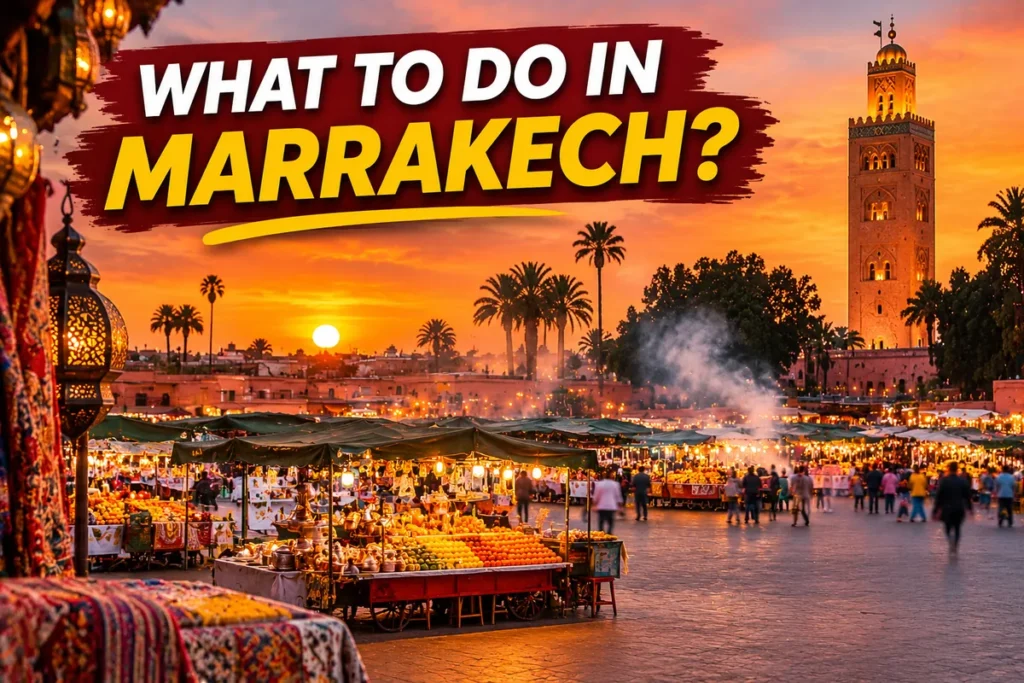

Marrakech is the city most people picture when they think of Morocco: the red walls, the snake charmers, the smell of spices and grilled meat drifting over Jemaa el-Fna at dusk. It is also a city that can overwhelm you if you arrive without a plan. We work in tourism in southern Morocco and send travellers to Marrakech every week, so this guide is the list we actually give them: the best things to do in Marrakech, how long each one takes, when to go, and the small tips that make the difference between a stressful day and a great one.
Things to do in Marrakech at a glance
- Must-see in the medina: Jemaa el-Fna square, the souks, Ben Youssef Madrasa, Bahia Palace, the Saadian Tombs, the Koutoubia.
- Gardens: Jardin Majorelle, Le Jardin Secret, the Menara gardens.
- Experiences: a hammam and scrub, a cooking class, a rooftop sunset, a night of street food.
- Day trips: the Agafay desert, the Ourika valley and Imlil in the Atlas, Ouzoud waterfalls, Essaouira.
- Time needed: two full days for the highlights, three or four to slow down and add a day trip.
1. Jemaa el-Fna, twice
Jemaa el-Fna is the beating heart of Marrakech, and it changes completely through the day. In the morning it is fairly quiet: orange juice stalls, a few henna artists and snake charmers. From late afternoon the musicians, storytellers and acrobats arrive, and at sunset rows of food stalls are set up, each with a number, benches and a cloud of smoke rising into the evening.
Our advice is to come twice. Once in the late afternoon to watch the square fill up from a café terrace, and once after dark to eat at the stalls. Agree on prices before you sit down, check what is included (bread and olives often appear on the table and may be charged), and choose busy stalls where locals are eating.
Good to know: if you take a photo of a performer or an animal handler, a small tip is expected. Ask first, or simply watch without the camera.
2. Get lost in the souks
North of Jemaa el-Fna, the souks are a maze of covered alleys where each area traditionally had its own trade: leather, metalwork, lanterns, carpets, spices, wood and textiles. Getting a little lost is part of the experience. Save the location of your riad offline, take a photo of the gate you came through, and do not worry if you walk in circles for a while.
Shopkeepers will invite you in, and young men may offer to “show you the way”. A polite “no, thank you” and walking on is enough. If you want to buy, bargaining is normal: start well below the asking price, smile, and walk away if it does not feel right. Our guide on what to buy in Morocco explains how to recognise quality and bargain fairly.
3. Ben Youssef Madrasa
This former Quran school is one of the most beautiful buildings in the country. The central courtyard, with its marble basin, zellige tilework, carved stucco and cedar wood, is breathtaking, and you can climb up to the small student rooms around it. Go early in the morning, before the tour groups arrive, if you want photos without crowds. Plan about an hour.
4. Bahia Palace
Built in the 19th century for a grand vizier, the Bahia Palace is a series of courtyards, gardens and richly decorated rooms. The painted ceilings are the highlight. It is popular and can feel busy, so again, morning visits are best. Plan about an hour, and combine it with the Saadian Tombs and the old Jewish quarter (the Mellah) nearby.
5. The Saadian Tombs and El Badi Palace
The Saadian Tombs were sealed off for centuries and only rediscovered in the early 20th century. The main chamber, with its carved marble and delicate stucco, is small but stunning, so expect a short queue to look inside. A few minutes’ walk away, the ruins of El Badi Palace give you a sense of the scale of the old royal city, and the walls are home to nesting storks. From the ramparts you get a good view over the medina.
6. The Koutoubia mosque
The minaret of the Koutoubia is the landmark of Marrakech, visible from almost everywhere in the city. Non-Muslims cannot enter the mosque, as is the case for most active mosques in Morocco, but the gardens around it are pleasant, and the minaret is beautiful at sunset when the call to prayer rings out across the square.
7. Jardin Majorelle and the YSL museum
Created by the painter Jacques Majorelle and later owned by Yves Saint Laurent and Pierre Bergé, this garden is famous for its intense cobalt blue villa, cactus collection and bamboo paths. It is small and very popular, so book a time slot online in advance and go at opening time. The Yves Saint Laurent museum next door is well worth adding if you are interested in fashion or design.
8. A quiet break at Le Jardin Secret
When the souks become too much, Le Jardin Secret is a beautifully restored riad garden right in the middle of the medina, with an Islamic garden on one side and an exotic garden on the other. You can also climb the tower for a view over the rooftops. It is a perfect pause between two busy visits.
9. The Menara gardens
An olive grove around a large basin with a green-roofed pavilion, the Menara gardens are less spectacular than Majorelle but very local and relaxed. On a clear day in winter or spring, you can see the snowy peaks of the Atlas behind the pavilion.
Finding our local guides useful? Add YouTours as a preferred source on Google.
10. Try a traditional hammam
The hammam is part of daily life in Morocco, and it is one of the best ways to understand the culture. You can go to a simple neighbourhood hammam with locals, or choose a spa hammam in a riad or hotel, where everything is provided. The classic ritual is heat and steam, black soap, a vigorous scrub with a kessa glove, sometimes a rhassoul clay mask, and then a massage with argan oil. You will come out feeling brand new.
11. Take a cooking class
Many riads and cooking schools offer half-day classes where you shop for ingredients, learn the spice mixes and cook a tagine or couscous with a local cook. It is a great activity for families and couples, and you leave with recipes to try at home. If you are staying on the coast, we run a Moroccan cooking class in Agadir (from €30) as well.
12. Watch the sunset from a rooftop
The medina is best seen from above. Several cafés around Jemaa el-Fna have rooftop terraces where you can sip a mint tea as the sky turns orange and the call to prayer echoes from mosque to mosque. Arrive a little before sunset to get a good table.
13. Visit the tanneries (with care)
The tanneries in the north-east of the medina show how leather has been treated for centuries. The smell is strong, and visits are often organised by men who approach you in the street and then ask for money or lead you to a shop. If you want to go, agree on a price before you start, or visit with a licensed guide.
14. Explore the new town, Gueliz
Outside the walls, Gueliz is the modern part of Marrakech, with wide avenues, cafés, galleries and restaurants. It is calmer than the medina and a good place for a relaxed coffee, some shopping at fixed prices, or dinner in a contemporary restaurant.
Best day trips from Marrakech
- Agafay desert: about an hour away, a stone desert with rolling hills, camel rides, quad biking and dinner camps under the stars. Ideal if you do not have time for the Sahara.
- Ourika valley and Imlil: green valleys and Berber villages in the Atlas mountains, with easy walks and fresh air. Imlil is the starting point for Toubkal treks.
- Ouzoud waterfalls: the highest waterfalls in Morocco, with monkeys and boat rides. It is a long day from Marrakech. See our Ouzoud waterfalls guide.
- Essaouira: a relaxed blue-and-white port town on the Atlantic, around three hours away.
- Hot air balloon: a sunrise flight over the palm groves and villages, followed by breakfast.
Visiting Marrakech from Agadir
Many travellers stay on the coast in Agadir and visit Marrakech in a day. It is doable, since the motorway takes about three hours each way, but it is a long day, so it works best with a driver and a guide who knows exactly where to go. Our Marrakech day trip from Agadir (from €45) includes hotel pickup and covers the main sights. If you prefer a slower pace, the 2-day Essaouira and Marrakech tour (from €300) lets you sleep in Marrakech and see Jemaa el-Fna at night. More details in our guide Agadir to Marrakech day trip.
How many days do you need in Marrakech?
- One day: Jemaa el-Fna, the souks, Ben Youssef Madrasa and either Bahia Palace or Majorelle. Tiring, but you will see the essentials.
- Two days: all the main monuments at a comfortable pace, plus a hammam and a rooftop sunset.
- Three or four days: add a cooking class and a day trip to the Agafay desert or the Atlas mountains.
If you are planning a longer trip, our Morocco itinerary for 7 and 10 days shows how to combine Marrakech with the desert and the coast.
Practical tips for Marrakech
- When to go: spring and autumn are the most pleasant. Summer is very hot, often well over 35°C. Winter days are sunny but nights are cold. See the best time to visit Morocco.
- Where to stay: a riad in the medina for the atmosphere, or a hotel in Gueliz or the Hivernage district for more space and quiet.
- Getting around: the medina is best on foot. For longer distances, use petit taxis and agree on the price or ask for the meter.
- Money: carry small notes and coins for taxis, tips and snacks. Our guide to money in Morocco explains cards, ATMs and tipping.
- Clothing: light, loose clothes that cover shoulders and knees are more comfortable and respectful in the medina. See what to wear in Morocco.
- Unofficial guides: people offering directions often expect money. If you want a guide, book an official one through your riad or a tour company.
- Friday: some shops close around midday prayer, and couscous is the traditional Friday lunch.
Is Marrakech worth visiting?
Yes, at least once. It is intense, crowded and sometimes tiring, but there is nowhere else quite like it. The trick is to balance the medina with quieter moments: a garden in the morning, a hammam in the afternoon, a rooftop at sunset. If you are not sure whether to base your holiday in Marrakech or on the coast, read our comparison Agadir or Marrakech? and, if you are considering the imperial cities, Fes or Marrakech.
FAQ: things to do in Marrakech
What is the number one thing to do in Marrakech?
Spending an evening at Jemaa el-Fna square, when the food stalls, musicians and storytellers bring it to life. It is the most famous experience in Marrakech.
Is two days enough for Marrakech?
Two full days are enough to see the main sights at a comfortable pace. Add a third day if you want a hammam, a cooking class or a day trip to the Atlas or the Agafay desert.
Can you visit Marrakech in a day from Agadir?
Yes. The drive is about three hours each way, so it is a long but rewarding day, especially with a guided tour that includes transport.
What should I avoid in Marrakech?
Following unofficial guides, accepting services without agreeing on a price first, and visiting in the heat of summer midday. Read our Morocco travel tips for first-timers before you go.
Is Marrakech safe for tourists?
Marrakech is generally safe for tourists. The main issues are pickpocketing in crowds and persistent touts. Our guide Is Morocco safe? covers everything in detail.
Planning a longer trip? See our guide to the best places to visit in Morocco, region by region.