
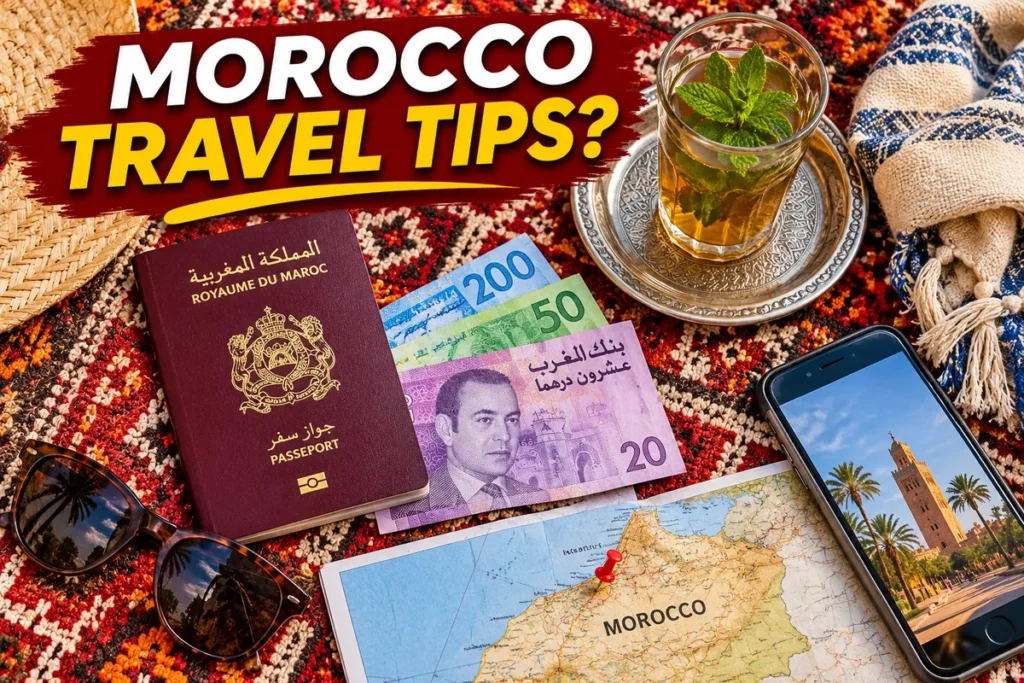
Your first trip to Morocco will probably surprise you. The colours, the noise of the medinas, the call to prayer, the hospitality and, yes, the occasional hassle can all feel like a lot when you arrive. The good news is that a few simple habits make everything easier. We live in Morocco and welcome first-time visitors every day, so these Morocco travel tips are the things we wish every traveller knew before landing: what to expect, what to do, what not to do, and how to avoid the classic mistakes.
Morocco travel tips at a glance
- Always agree on a price before a service: taxi, guide, porter, henna, photo.
- Dress modestly in towns, normally on the beach.
- Carry small change in dirhams for taxis, tips and snacks.
- Ask before taking photos of people.
- Say “la, choukran” (no, thank you) with a smile and keep walking.
- Most active mosques are closed to non-Muslims.
- Do not eat or drink in the street during the day in Ramadan.
- Plan fewer places and more time: distances are long.
Before you go
1. Check entry requirements
Many nationalities, including most of Europe, the UK, the US and Canada, can enter Morocco without a visa for short tourist stays, but rules change and depend on your passport. Check the official requirements for your nationality before booking, and make sure your passport is valid for your whole stay.
2. Choose the right season
Spring and autumn are the most comfortable for touring. Summer is extremely hot inland and in the desert, while winter is mild on the coast but cold at night in the mountains and the Sahara. Our guide to the best time to visit Morocco breaks it down region by region.
3. Don’t try to see everything
Morocco is big, and the famous places are spread out. A week is perfect for two regions, not the whole country. Our Morocco itinerary for 7 and 10 days shows realistic routes.
4. Get travel insurance
Standard advice, but important if you plan activities like quad biking, surfing, trekking or desert trips.
Money and payments
5. Use dirhams, not euros
The Moroccan dirham is a closed currency, so you usually get it on arrival. ATMs are everywhere in cities. Some places accept euros, but at a poor rate. Pay in dirhams and keep small notes and coins. Everything is explained in our guide to money in Morocco.
6. Agree on prices before, not after
This is the single most useful tip in this article. Taxis without a meter, guides, porters, henna artists, people who pose for photos, even the bread and olives that arrive at your table: ask “how much?” first. It is completely normal here and avoids 90% of misunderstandings.
7. Bargaining is part of the culture
In souks and small shops without price tags, bargaining is expected and can be fun. Start well below the asking price, stay friendly, and walk away politely if it does not suit you. Never bargain in supermarkets, pharmacies or shops with fixed prices. For tips on quality and fair bargaining, see what to buy in Morocco.
8. Tip, but modestly
Round up taxi fares, leave around 10% in restaurants if service is not included, and give small tips to porters, guides and hammam attendants. Tips are appreciated but never huge.
Culture and etiquette: what to do and what not to do
9. Dress for the place
Normal swimwear is fine on the beach and by the pool. In towns, medinas and villages, clothes that cover shoulders and knees are more respectful and will make you feel more comfortable, with less attention. This applies to men and women. See what to wear in Morocco.
10. Ask before photographing people
Many Moroccans, especially women and older people, do not like being photographed. A smile and a gesture asking permission is usually enough. Performers and animal handlers in squares expect a few dirhams for photos.
11. Respect mosques
Unlike many other countries, most active mosques in Morocco are reserved for Muslims. Notable exceptions open to visitors include the Hassan II mosque in Casablanca (on guided tours) and the Tinmel mosque in the High Atlas. You can of course admire mosques from outside.
12. Be aware of Ramadan
During Ramadan, Muslims fast from dawn to sunset. Tourist restaurants and hotels stay open, but avoid eating, drinking or smoking openly in the street during the day. Evenings are festive, and breaking the fast (iftar) is a wonderful experience if you are invited.
13. Use your right hand
When eating from a shared dish or handing something to someone, use your right hand. Bread is often used as a scoop instead of cutlery.
14. Accept the mint tea
Tea is hospitality. If you are offered a glass in a shop or a home, accept at least one. It does not oblige you to buy anything.
15. Public displays of affection
Holding hands is fine, but kissing in public is frowned upon outside very touristy places. Be discreet.
16. Alcohol
Alcohol is available in licensed hotels, bars and some restaurants, and in certain supermarkets, but drinking in the street is not acceptable.
Dealing with hassle and common scams
17. “The square is closed” and other tricks
In busy medinas, you may hear that a street is closed, that the tanneries are “only open today”, or someone may insist on showing you the way. These are usually ways to lead you to a shop or ask for money. Smile, say “la, choukran”, and continue with your map.
18. Unofficial guides
If you want a guide, book an official one through your riad, hotel or a tour company. Official guides carry a badge and agree on a fixed price.
19. Henna ambush
In some squares, a henna artist may grab your hand and start drawing before you agree. Pull your hand back politely and firmly if you do not want it.
20. Taxis
Petit taxis in cities should use the meter. Ask for “le compteur” as you get in, or agree on the price before. At airports, grand taxis use fixed fares. See our guide on Agadir airport to the city for an example.
For a broader view of safety, read Is Morocco safe for tourists?
Health and comfort
21. Water and food
Many visitors prefer bottled water. Street food is generally safe if you choose busy stalls where food is cooked in front of you. Ease into spicy and rich dishes during your first days.
22. Sun and heat
The sun is strong, even when the Atlantic breeze makes it feel cool. Use sunscreen, a hat and drink plenty of water, especially in the desert.
23. Pharmacies
Pharmacies are everywhere, marked with a green cross, and pharmacists are very helpful for minor issues.
Getting around
24. Trains, buses and tours
Trains are comfortable in the north. Intercity coaches cover most of the country. For the desert, the Atlas and remote places, organised tours or a private driver are the easiest option.
25. Medina navigation
Phone maps are sometimes inaccurate in the narrow alleys. Save your riad’s location offline, take a photo of its door and the nearest landmark, and ask shopkeepers rather than random people for directions.
Finding our local guides useful? Add YouTours as a preferred source on Google.
Language and communication
26. Learn a few words
- Salam alaykoum: hello
- Choukran: thank you
- La, choukran: no, thank you
- Bshhal?: how much?
- Inshallah: God willing (you will hear it constantly)
Arabic and Berber (Amazigh) are the official languages, French is widely spoken, and English is common in tourist areas.
27. Get a local SIM or eSIM
Mobile data is cheap and makes maps, translations and messaging much easier.
Making the most of your trip
28. Balance the busy and the calm
The medinas are exciting but tiring. Alternate with gardens, a hammam, the beach or a day in nature. A trip combining Marrakech with the coast around Agadir is a great balance. See Agadir or Marrakech?
29. Try the experiences, not only the sights
A hammam, a cooking class, a night in a desert camp, a seafood lunch at the port, a camel ride at sunset: these are often what travellers remember most. From Agadir, our sunset camel ride with BBQ dinner (from €35) and hammam with argan oil massage (from €39) are easy first experiences.
30. Leave room for the unexpected
Some of the best Moroccan memories are unplanned: an invitation to tea in a village, a wedding procession passing in the street, a market day you did not know about. Keep a free afternoon in your schedule.
31. Be open and patient
Things sometimes run on “Moroccan time”, plans change, and conversations take longer. Embrace it. Moroccan hospitality is real, and the best moments often come from a chat over tea.
Your first day in Morocco: a simple plan
The first 24 hours set the tone for the whole trip, so keep them easy:
- At the airport: withdraw some dirhams, buy a SIM or activate an eSIM, and take an official taxi or a pre-booked transfer.
- Check in and rest: flights are tiring, and the medina will still be there in two hours.
- Take a short walk with a goal: a café on a square, the beach promenade, or the main street near your hotel. Get used to the sounds and the rhythm.
- Have a simple dinner nearby: a tagine or grilled fish in a busy local place.
- Book a guided visit for day 2: a city tour with a local guide is the fastest way to understand where things are, how prices work and what is worth your time. In Agadir, our guided city tour starts from €15.
Packing checklist for a first trip
- Light, loose clothing that covers shoulders and knees, plus swimwear for the coast.
- A warm layer for evenings, especially in the desert and mountains.
- Comfortable shoes with good grip for uneven medina streets.
- A scarf or light shawl: sun, wind, dust and visits.
- Sunscreen, sunglasses and a hat.
- A small day bag that closes properly, for crowded places.
- Hand sanitiser and tissues: not every café has soap or paper.
- A power adapter (Morocco uses the European two-pin plug).
- Some euros or pounds in cash to exchange, as a backup to your card.
Useful apps for travelling in Morocco
- Offline maps: download the area before you go, as signal can drop in the medinas and mountains.
- A translation app: with Arabic and French offline packs.
- A currency converter: to check prices quickly when bargaining.
- WhatsApp: almost every riad, driver and tour company in Morocco uses it to confirm bookings and pickup times.
What shocks first-time visitors in Morocco
We often ask our guests what surprised them most. The most common answers:
- The intensity of the medinas: noise, motorbikes, donkeys, crowds, all in tiny alleys.
- How persistent sellers can be, and how quickly they stop when you are firm but polite.
- How warm and generous people are, especially outside the big tourist spots.
- How cold the desert gets at night.
- How good the food is, and how much bread is served with every meal.
- How varied the country is: snow, desert, beaches and green valleys in one trip.
FAQ: Morocco travel tips
What should I not do in Morocco?
Don’t accept services without agreeing on a price, don’t photograph people without asking, don’t dress in beachwear in towns, don’t enter active mosques unless they are open to visitors, and don’t eat in the street during the day in Ramadan.
Is Morocco good for first-time travellers?
Yes. It is welcoming and well organised for tourism. Starting in a calmer place like Agadir or Essaouira, or with a guided tour, can make the first days easier.
Do I need to speak French in Morocco?
No. French is widely spoken, but English is common in tourist areas, and a few words of Arabic are always appreciated.
Can I drink tap water in Morocco?
Many travellers prefer bottled or filtered water to avoid stomach problems, especially during the first days.
How should women dress in Morocco?
In towns, loose clothes covering shoulders and knees are comfortable and respectful. On the beach, normal swimwear is fine. A scarf is useful but not required.